The tick is not the thing

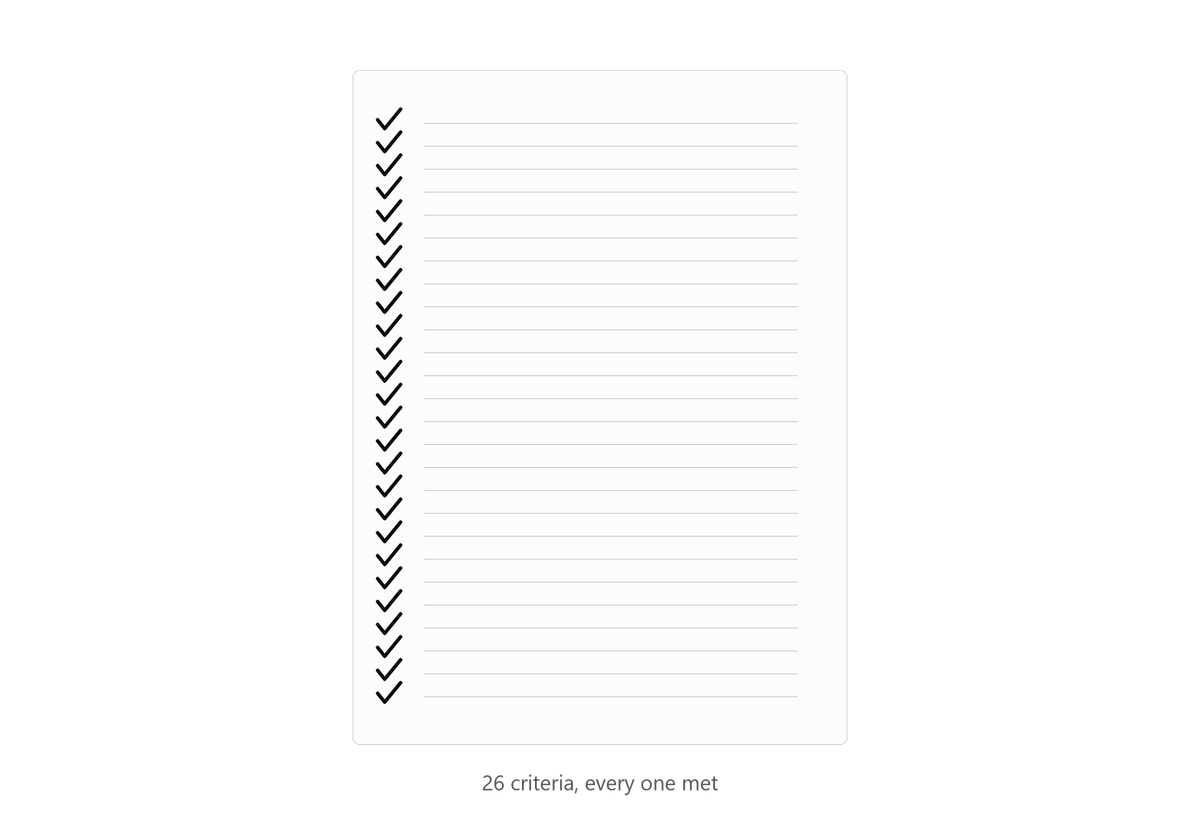
In May 2024 I submitted 181 pages as evidence that I had become more self-aware.
The folder held 29 weekly journals of 300 to 500 words each, four unit assignments running from 500 to just under 3,000 words, peer feedback sheets, a creative piece on identity that came in at 504 words within a permitted tolerance of plus or minus ten per cent, and a signature confirming the work was my own. My tutor, who is patient and unusually good at knowing when to say nothing, had worked through it and placed a small tick in the margin against each of the 26 assessment criteria.
Collating it took most of a weekend. Halfway through I stopped and wrote that week's entry, which is the reason for this article.
“All of it measurable. All of it evidenced. All of it true.
The thing it was for isn't any of those.
The tick isn't for the self awareness. It's for the paragraph about the self awareness.
Can you evidence the inside of your own head? No. You can evidence that you went in there and came back with a report. Nobody can check the report.”
I have been turning that over since, because it is not a problem specific to counselling training. It is the ordinary condition of most of the work I do.
Starting with the definition
Duval and Wicklund's account, which is the one later work builds on, describes self-awareness as attention turned inward, so that a person compares themselves against their own standards and generally finds the comparison uncomfortable. That seems right to me. It also gives me nothing.
It describes the state without offering any way of detecting whether it is present in someone else or in me. Tasha Eurich's more recent work makes this harder rather than easier by splitting the thing in two: internal self-awareness, meaning how clearly you see your own values and reactions, and external self-awareness, meaning how accurately you understand the way you land on other people. Eurich reports that the two are largely independent: someone may understand their own motives in considerable detail while remaining unable to see how they affect other people.
So there are at least two quantities here, neither directly observable, which can move independently. This is not an encouraging starting position for anybody hoping to certify the result.
The problem is not that an unobservable quality leaves no evidence. Most of the things institutions care about are inferred rather than inspected. The problem is that the inference can quietly disappear from view. Evidence of reflection becomes reflection; reflection becomes self-awareness; and self-awareness becomes something a tick appears to certify.
The same problem, in a different building
An actuary will recognise the shape of this long before recognising the subject.
A regulator cannot inspect whether the people inside a firm will speak up when something looks wrong. That is the thing it actually wants to know, and it is not available. So it inspects training completion rates, attestations, the composition and minutes of the risk committee, the existence of a whistleblowing line and the volume of calls to it. Model validation works the same way. What ends up in the file is that a review took place, on a stated date, by someone sufficiently independent, against documented criteria. The file can record the reasoning, challenge and tests that surrounded the judgement. It cannot settle whether the judgement itself was good. At some point the evidence ends and another judgement begins.
I noticed the resemblance in the same sitting, and what I wrote about it is less comfortable than the paragraph above.
“Same problem at work and I have never once said it out loud.
I have written a lot of validation reports. I have never put that point in one. I haven't seen anyone else do it either.”
Goodhart's law describes what can happen when a proxy becomes a target. But there is an earlier and quieter failure. A proxy does not have to be gamed to mislead. It only has to become easier to discuss than the thing for which it stands.
That is the risk with a folder of 181 pages. It is not that anyone lies in it. It is that the folder is legible, gradeable and filed, and the thing it points at is none of those, so over time the conversation drifts towards the part that can be handled.
Both directions
Could someone assemble an entire portfolio and finish with almost no self-awareness? I think so, and I would not estimate the probability to be remote. Reflective writing has a house style, and it takes about three weeks to learn: notice the feeling, name it, link it to something from childhood, extract the learning point. I have reread my own journals and can find passages where that is all I was doing. They are not the worst pages in the folder. They are the tidiest.
Could someone develop deep self-awareness with no portfolio? Almost certainly. Most of the people I would describe as genuinely self-aware have never kept a reflective log and would find the suggestion faintly embarrassing.
So the evidence is neither necessary nor sufficient. The portfolio is not equivalent to the quality it is intended to evidence.
That could be taken as a verdict on the whole exercise, and I don't think it is one. Take two people at the start of a nine-month course, one who will write 29 journals and one who will write none, and ask which is more likely to know something about themselves at the end that they didn't know at the start. I would take the first. Not confidently and not at long odds, but at better than even and I would want to be paid something to take the other side.
That is a probabilistic claim about a shift in likelihood. The folder looks like a certificate.
Perhaps I had misunderstood what it was claiming. It is weak evidence that self-awareness arrived, and rather better evidence that the course repeatedly created conditions in which it might. Those are different claims, and only one of them is on the front of the folder.
What separates an honest proxy from a dishonest one
Three things, on a fairly cursory reading of my own experience of both.
The first is that it is named as a proxy, every time, including in the places where naming it is inconvenient. Stating plainly what is being observed and what is being inferred from it. The dishonest version never announces itself. It simply stops mentioning the distinction, and after a while nobody remembers there was one.
The second is that the strength of the link is claimed at the strength the evidence supports. Loosely correlated, in the direction we want, is an honest description of most of what we count. It is rarely how it appears in a summary paper.
The third is that someone is actively looking for the cases where the proxy is satisfied and the thing does not follow. That means treating gaming as the expected behaviour of a reasonable person under the incentives, rather than as a character failing to be discovered later. If completing the exercises is what gets assessed, completing the exercises is what will be optimised, and there is nothing surprising or disgraceful about that.
Which kind of proxy mine was, I have no way of establishing, and this last journal entry is the reason why.
“If I had learnt nothing in those nine months, who is least likely to notice?
Me. Obviously me. The whole argument is that inward attention is an unreliable instrument, and the instrument doing the checking is the instrument under test.”
That is not a rhetorical flourish. It is the actual position, and it does not improve on inspection.
Islamic theology has a formulation of Allāhu akbar that means not merely that God is greater than other things, but that God is greater than can be described. It concerns a much deeper inaccessibility than the one troubling me here, and I do not want to pretend that the two are equivalent. But the structure is familiar: what reaches language is not the thing itself, but an account shaped by the limits of the person giving it. I have arrived at a faint psychological version of that problem by a considerably less interesting route.
What I can't establish
The folder cannot settle it. Neither can this article, which is one more piece of reflective writing produced by the person under examination and filed by the person under examination. I have spent 1,500 words demonstrating that I am aware of the limits of evidence for self-awareness, which is either a mild irony or the whole problem restated, and I am not sure I can tell the difference from here.
What I am left with is a distinction rather than an answer. There is something I care about, which cannot be observed. There is evidence of having tried, which can be counted precisely and which I have counted precisely, down to the tolerance on the word limit. The second is worth having. It is simply not the first, and the gap between them does not close by producing more of the second.
Most of us are assessed, at work and elsewhere, on something adjacent to the thing that actually matters. How much of what you count is quietly standing in for something you have already agreed cannot be measured, and when did you last put that in writing where someone would see it?